Muted body and metadata text does not meet readable contrast
The accessibility scan reports repeated text contrast ratios of 3.35:1 and 3.44:1, plus a 2.11:1 instance, on the landing page.category: accessibility · finding 1dd603d2
release pass · proof v1.4.2 · 20 free screen checks
Greenroom reads your git diff to choose the screens most likely to break, then a virtual user walks your iOS Simulator or web build and returns an evidence-backed QA handoff on the PR. Advisory, never blocking, priced per screen the diff touched.
After the first session, an error toast sits on top of the purchase button for about four seconds. That's the moment a new user decides whether to pay.
On 26 August 2026, Greenroom's first end-to-end run outside the eval harness walked this landing page from a real change set and posted three P2 findings as a GitHub Check. All three were real defects in this site. This release fixes them.
The accessibility scan reports repeated text contrast ratios of 3.35:1 and 3.44:1, plus a 2.11:1 instance, on the landing page.category: accessibility · finding 1dd603d2
The release-pass card presents “no blockers” while simultaneously displaying “paywall · toast overlaps CTA” and a P2 finding.category: coherence · finding 59e72582
The structured scan reports anchor targets as small as 58x16, 94x16, 161x34, and 350x17.category: accessibility · finding c6023082
Open the report your team would receive: scope, release context, passed checks, reproducible findings, screenshots, and likely code pointers. The sample is fictionalized and clearly labeled.
Read the sample handoffFresh account → complete session → Done → paywall. The error toast covers the purchase button for four seconds.
likely: src/services/sync.ts:835 · rubric: state-coherenceGreenroom decides where to look, opens the product, judges what happened, and leaves a handoff a person or coding agent can use.
Diff-scoped instead of rerunning the whole app.
Actually walks the browser or iOS simulator.
Judges evidence against your product rubric.
Returns a scoped verdict with repro and code pointers.
There are no per-flow test scripts to write or maintain. Greenroom maps your diff to the screens it likely affects and walks those, plus your revenue path, every time.
The coverage map connects changed files to reachable screens, keeps your core path always on, and calls out routes the walk could not reach.
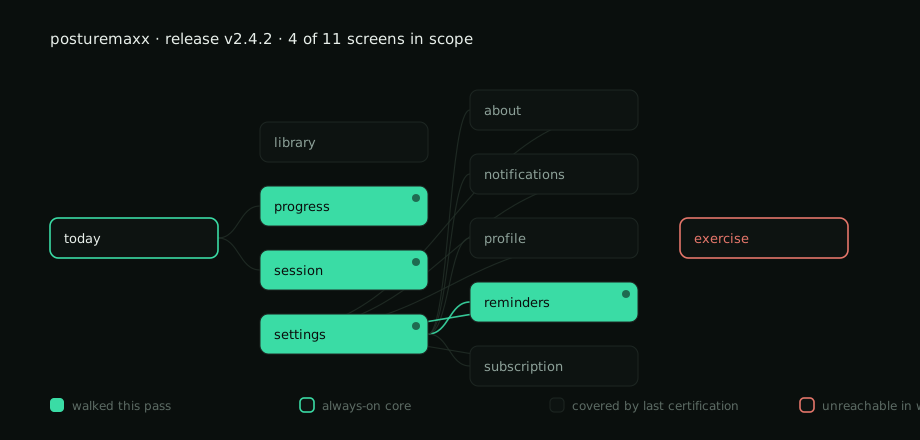
A scripted test can confirm the button submits. It can't notice that the copy drifted off-voice, or that Settings says "Free" while the paywall says "Trialing." Greenroom reviews every walk against your rubric, and each finding cites a screenshot and a code pointer.
When Claude Code or Codex ships a feature overnight, someone still has to open the app and use it. Greenroom is that someone. Every pull request your agent opens gets walked, and the handoff lands as a GitHub Check with a file and line, so the agent or you can fix what it finds before a human opens the PR.
direct agent access over MCP is planned · not yet availableThe agent that wrote the code will happily approve it. Greenroom walks the same build as an independent user, with the same scope and rubric on every release.
Trigger passes from GitHub today, return the verdict to the PR as a Check, and keep an eye on what is planned next without inventing another release ritual.
Runs a scoped pass on every pull request and posts the handoff as a GitHub Check on the PR. Read-only repository access through the Greenroom GitHub App.
Reuse the simulator build EAS already produced as the pass input, so JS-only releases skip the rebuild. Not available yet.
Let a coding agent request a pass, read the verdict, and re-verify from inside its own loop. Not available yet; today agents read the Check on the PR.
a screen check means we walk and judge one screen in one state · every workspace starts with 20 free screen checks before a plan is required
Launch partners · 50% off Team for six months with the launch-partner code at checkout
Planned · Slack digest
Start on TeamPlanned · API access · daily certifications
Talk to usTell us about the app: React Native, Expo, Swift or web, which flows matter, and what you want a pass to catch. We reply by email. There is no sales call to book.
Self-serve is the fast path: sign in with GitHub, install the app on one repository, merge the setup files, open a pull request.
on: pull_request · advisory · iOS Simulator + web or read a full handoff from proof v1.4.2 →Greenroom gets only the access needed for the pass your workflow runs. Contact details are stored privately and used only to reply.
Only the build your own CI produces for the pass. Nothing is uploaded from a form.
A disposable test account inside an allowlist you approve.
Read-only access for scope and code pointers. No commits.
Passes start from your workflow on your pull requests. Nothing runs until you merge the setup files.
Not unless you ask it to. Passes are advisory by default. During the pilot, findings are advisory. Automated release blocking is unavailable until independently reproduced failure gates are validated.
The build your CI produces, in a simulator or a browser, using a disposable test account inside a network allowlist you approve. Repo access is read-only, and it never pushes commits.
No. Your unit tests and scripted smoke suite still run first and still gate merges. Greenroom walks the parts a script can't judge.
Timing depends on the scope we map for your app. The first live run on this page took 42 seconds for one goal; scoped release passes are designed to finish in minutes, and we will publish measured timings as public dogfooding continues.
iOS on the Apple Simulator and web against your preview deploys. The handoff format is the same on both.